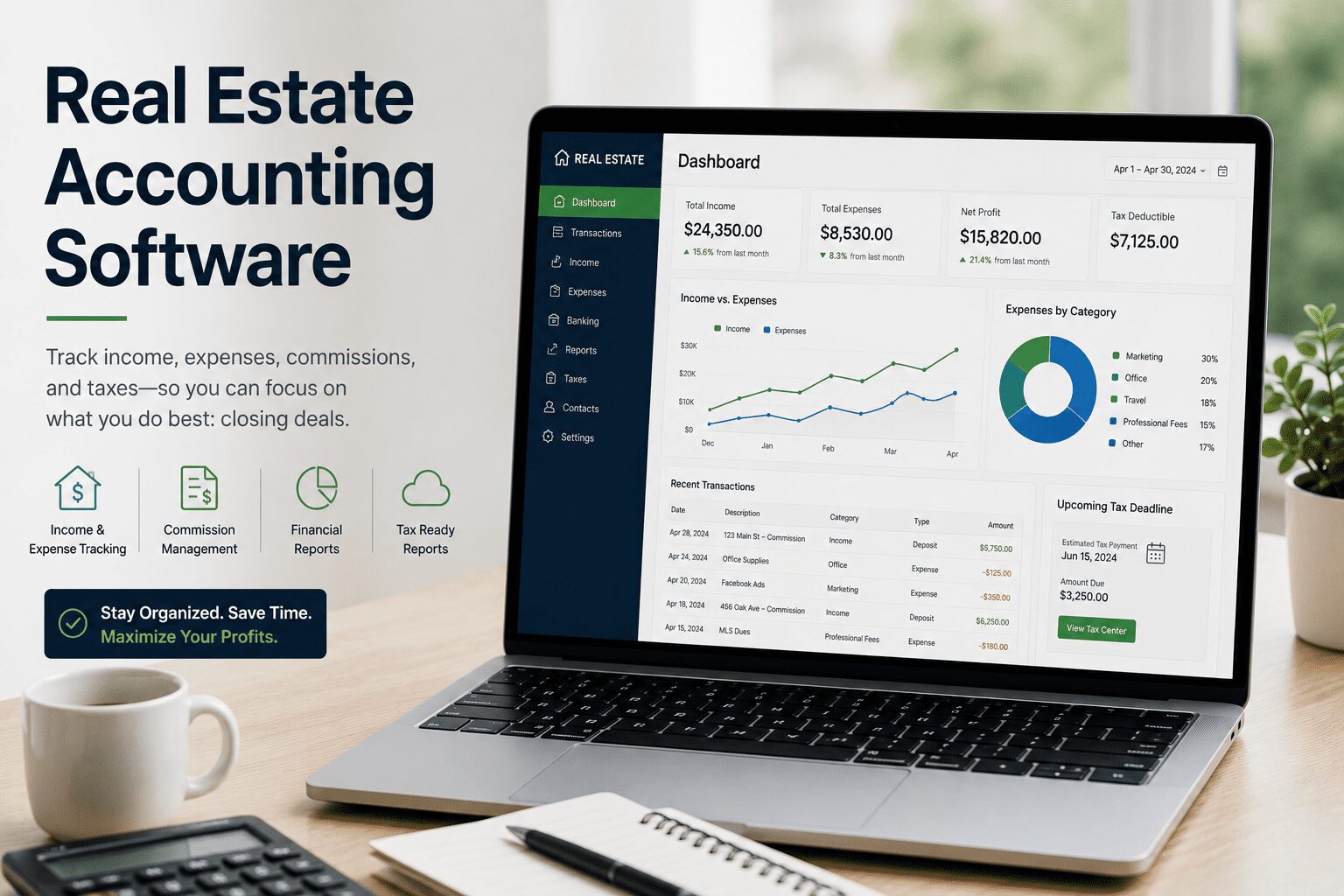
Real estate agent accounting is simpler than most agents make it, and more consequential than most treat it until tax season reveals the gap between what they thought they owed and what they actually owe. Getting accounting right as a self-employed real estate agent is not about sophisticated financial management. It is about consistent tracking of income and expenses throughout the year so that no decision made at tax time is a surprise.
The tools available to real estate agents for accounting range from free spreadsheets to full accounting software platforms. Understanding what each actually provides, which features matter for a solo agent running a real estate practice, and which features are unnecessary overhead helps you pick something you will consistently use rather than the most feature-rich option that sits untouched because it is more complicated than your actual needs require.
What Real Estate Agents Actually Need to Track
Commission income is the starting point. Every commission received should be recorded with the amount, the date received, and the transaction it came from. This is your gross income before split and before expenses, and it is the number your accounting must start from.
Business expenses are the second category. Real estate agents typically have a substantial list of deductible business expenses. MLS dues. Association fees. Brokerage fees and desk fees. Technology subscriptions including your CRM, IDX service, email marketing tool, and other software. Marketing expenses including your website, advertising, and social media tools. Vehicle mileage, which is often the largest single deduction available to active real estate agents. Home office expenses if you use a dedicated space. Continuing education and licensing fees. Business meals with clients and referral partners. Business cards, signs, and other promotional materials. Professional development including coaching, courses, and conferences.
Estimated quarterly tax payments need to be tracked separately from income and expenses because they affect your cash flow throughout the year. Most self-employed agents owe federal estimated taxes quarterly and state estimated taxes in states that collect income tax. Knowing what you have already paid, and what you owe for the current quarter, requires tracking these payments alongside your regular business activity.
The Separation of Business and Personal Finances
Before any accounting tool matters, you need a dedicated business bank account and ideally a dedicated business credit card. Mixing business and personal transactions in the same accounts is the single biggest source of accounting complexity for self-employed agents. When every transaction is in a shared account, every statement review becomes a manual sorting exercise to identify which transactions were business and which were personal.
A dedicated business account means every transaction in that account is either business income or a business expense. Statement review becomes a confirmation that everything is categorized correctly rather than a first-pass sorting exercise. The time savings over the course of a year are significant, and the tax documentation is cleaner and more defensible in the unlikely event of an audit.
QuickBooks Self-Employed
QuickBooks Self-Employed is designed specifically for independent contractors and self-employed professionals and is the most commonly recommended accounting tool for real estate agents who want a low-overhead solution that handles the core requirements without unnecessary complexity.
The platform connects to your bank accounts and credit cards and automatically imports and categorizes transactions. The categorization is not perfect but it is good enough that most transactions are correctly categorized without manual intervention, and the ones that are miscategorized are easy to fix. You can set rules for recurring transactions so that your IDX subscription always categorizes as technology expense and your MLS dues always categorize as professional fees.
The mileage tracking feature in the mobile app is one of QuickBooks Self-Employed’s most practical features for real estate agents. Vehicle mileage is one of the largest available deductions for active agents who drive to showings, listing appointments, and client meetings. The app tracks mileage automatically using GPS and allows you to swipe each trip as business or personal. The annual total is calculated automatically and feeds directly into the tax summary. The IRS standard mileage rate in 2024 was 67 cents per mile, which means 10,000 business miles produces a $6,700 deduction. Most active agents drive significantly more than that.
Quarterly estimated tax calculations are built into the platform. Based on your income and expenses to date, QuickBooks Self-Employed tells you what you owe for the current quarter and generates a payment voucher you can use to remit payment. This feature alone is worth the subscription cost for agents who have historically underpaid quarterly taxes and faced penalties.
At tax time, the platform generates a Schedule C summary that your accountant can use directly or that you can use for tax software. The category breakdown maps to Schedule C line items, which eliminates the sorting work your accountant would otherwise need to do on your behalf.
Pricing starts around $15 per month for the standard plan. A bundle with TurboTax Self-Employed is available for a higher monthly rate and makes sense for agents who file their own taxes rather than working with an accountant.
Wave Accounting
Wave is a free accounting platform that covers income tracking, expense categorization, invoicing, and basic financial reporting. It does not have the mileage tracking or quarterly tax estimation features of QuickBooks Self-Employed, but for agents who handle mileage tracking separately and work with an accountant for quarterly tax estimates, the core accounting functionality is solid and the price is hard to beat.
Wave connects to bank accounts for transaction import and categorization. The interface is less intuitive than QuickBooks but functional for agents who are willing to spend some time with the setup. For agents on tight margins who want to keep overhead costs low while maintaining organized books, Wave is a legitimate option.
QuickBooks Online
QuickBooks Online is the full accounting platform appropriate for agents who have formed an S-corp, who have employees or paid contractors, or who are running team operations with enough financial complexity to justify more robust software. The feature set goes significantly beyond what most solo agents need and the monthly cost reflects that, starting around $35 per month and scaling up based on the plan.
For a solo agent operating as a sole proprietor or single-member LLC, QuickBooks Self-Employed covers the requirements at a lower cost. QuickBooks Online makes sense when payroll, complex invoicing, project-based accounting, or multi-entity financial tracking becomes necessary.
The Habit That Matters More Than the Tool
Whatever accounting tool you choose, the practice that determines whether your books are accurate is weekly reconciliation. Spending ten to fifteen minutes each week reviewing imported transactions, confirming categorizations are correct, logging mileage from the week, and noting any cash transactions that need manual entry keeps your books current throughout the year.
The alternative, reviewing six months of transactions in October or every transaction in March, is where accounting feels overwhelming and where mistakes happen that cost money at tax time. The tool is infrastructure. The weekly habit is what makes it work. Starting the habit when you choose the tool, rather than waiting until the books are already behind, is the only way to establish it before the first difficult reconciliation session.
Lori Ballen is a digital entrepreneur and content creator based in Las Vegas. She founded Ballen Brands, now owned and operated by her brothers Jeff and Paul Helvin.
Hey there! Just a quick heads-up: some of the links on this site are affiliate links, meaning I may earn a small commission if you make a purchase (including through the Amazon Associates program), at no extra cost to you. Occasionally, products featured here are gifted by brands.
I also use AI tools to help research and create content for you! While I love sharing strategies to help you succeed, please remember that everyone's journey is unique—individual results vary, and there are no guarantees. Thanks so much for stopping by!